Summarize, question, and visualize any research paper.
A serverless AWS platform that searches arXiv and Semantic Scholar, fetches full-text PDFs, and produces structured summaries plus a retrieval-augmented chat and an interactive knowledge graph — all in about thirty seconds per paper.
- Paper → summary
- ~30s
- Lambdas, 7 stacks
- 13
- Per summary
- $0.20
- Idle cost
- 0
Product
What you can do once you sign in
Everything below is live in production today. Sign up, paste a topic, and get back a structured summary, an interactive chat, and a knowledge graph in under a minute.
Search
Search across two sources
arXiv and Semantic Scholar queried in parallel, deduped by arxivId / DOI / normalized title. Phrase-quoted title boost so an exact title returns the right paper.
Summarize
Structured summaries
A five-section structured summary — Objectives, Methodology, Results, Limitations, Contributions — plus auto-extracted keywords, generated end-to-end in about thirty seconds.
RAG chat
Talk to the paper
Ask any question about a paper. Each answer is grounded in retrieved chunks with inline citation tooltips showing chunk number, similarity score, and excerpt.
Visualize
Knowledge graph
Auto-extracted entities (methods, datasets, metrics, results) and relationships rendered as an interactive graph with a key-concepts rail and click-through neighbours.
Discover
Library similarity
Mean paper-level embeddings let us surface the three most similar papers from your own library, side-by-side with the one you are reading.
Export
One-click export
Copy any summary as Markdown, download as .md, or grab a clean BibTeX entry with the canonical lastnameYear key.
Architecture
Serverless on AWS, end to end
Every service is managed — no virtual machines, no containers to babysit, no idle compute charges. The async pipeline is orchestrated by Step Functions; LLM and embedding calls go through Amazon Bedrock.
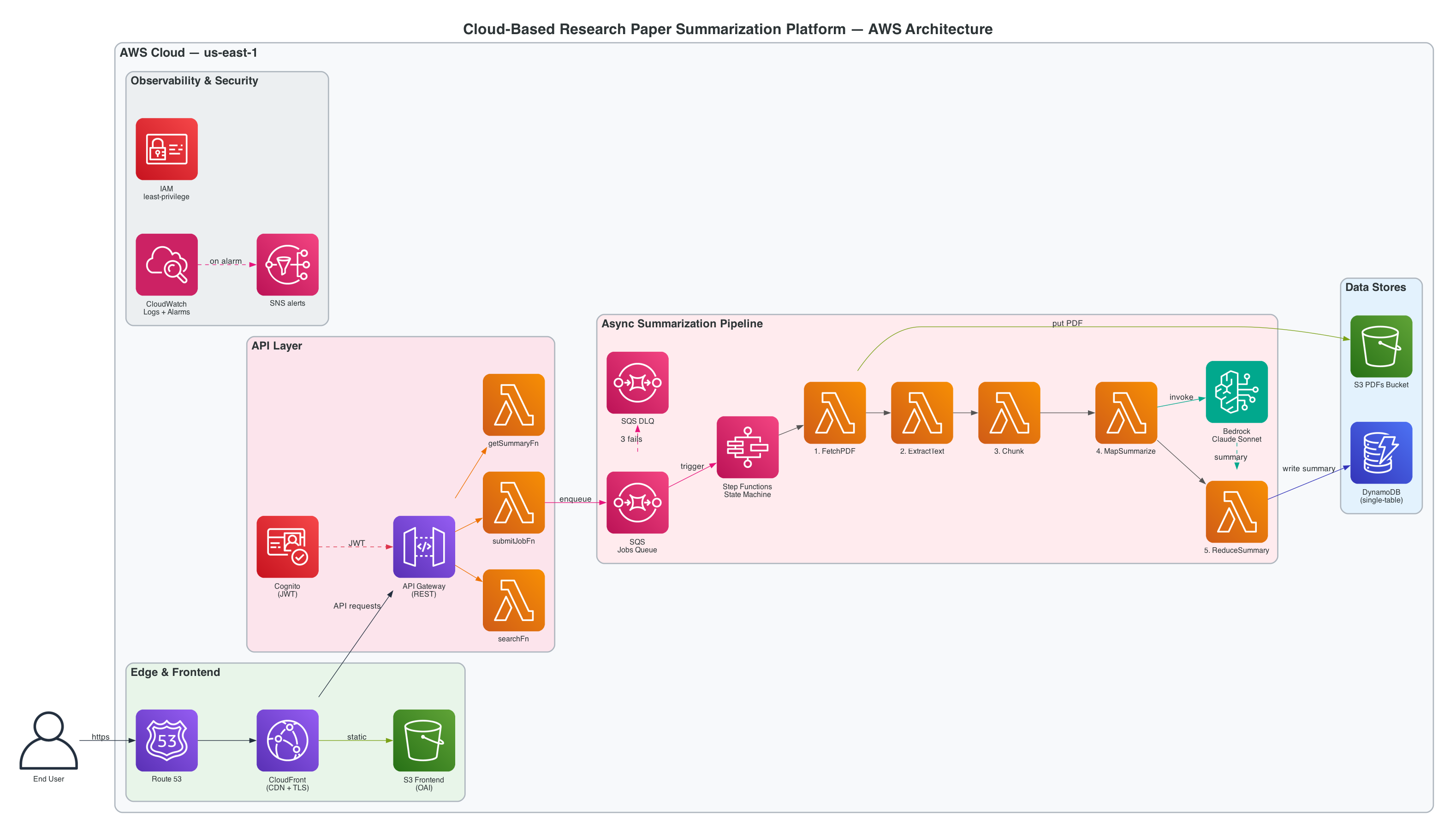
Figure 1 — AWS deployment topology
Services
Every piece earns its place
Nine functional areas spanning thirteen Lambdas and seven CDK stacks. Hover for the role each one plays.
Edge
Route 53 + CloudFront
DNS, HTTPS on a custom domain, and global edge caching sit in front of the static frontend. A CloudFront Function rewrites nested SPA routes server-side.
Auth
Amazon Cognito
Managed user pool with email verification, SRP login, and forgot-password flow. API Gateway validates JWTs before any Lambda runs.
API
API Gateway + 13 Lambdas
REST entrypoint with eight authenticated endpoints — health, search, summarize, list/get summaries, related, graph, chat, quota.
Orchestration
SQS + Step Functions
Async pipeline: SQS decouples the API from long work; Step Functions coordinates five Lambdas with retries, parallel map, and a failure handler that flips DynamoDB.
LLM + embeddings
Amazon Bedrock
Qwen 3 Next 80B (Claude Sonnet swap-ready) for summarization, chat, and graph extraction. Titan Text Embeddings v2 for chunk vectors.
Data
DynamoDB + S3
DynamoDB single-table for users, jobs, summaries, embeddings, and graphs with one GSI for cross-user dedup. Two S3 buckets — frontend and raw PDFs with lifecycle policy.
Observability
CloudWatch + X-Ray
Structured JSON logs, four alarms wired to SNS email, X-Ray traces across every Lambda and Step Function execution, an operations dashboard, and an AWS Budgets alarm.
Infrastructure as Code
AWS CDK
Seven reproducible TypeScript stacks — Auth, Data, Pipeline, Api, Frontend, Ops — deployable from scratch with one command.
CI
GitHub Actions
Lint and build on every pull request. The whole infra is checked with cdk synth before merge.
Production numbers
Verified, not aspirational
Every number below comes from real executions on the live deployment.
- End-to-end summary
- 27–44s
- Search P95 latency
- ~1.4s
- Cost per summary
- $0.20
- Idle infrastructure
- $0
- Tests passing
- 14 / 14
- API 5xx errors
- 0
- Knowledge graph
- ~25s
- Free tier coverage
- 100%
real arXiv papers
arXiv + Semantic Scholar in parallel
Bedrock-dominated
serverless, pay-per-use
vitest
lifetime
first call, instant after
excluding Bedrock
Team
Four engineers, one repo
One owner per architectural area. Everyone reviews everyone else's pull requests.
Shreyas Sankpal
Pipeline & Orchestration
Pranjal Mishra
Architecture & Frontend
Yang Zheng
Search & Data Layer
Kerry Huang
Auth & API